1. Giới thiệu
The Two Notes Torpedo Captor 4 is a versatile device designed for guitar and bass players using tube amplifiers. It functions as a reactive load box, an attenuator, a direct injection (DI) box, and a speaker simulator. This unit allows you to safely connect your tube amplifier without a speaker cabinet, reduce your amplifier's volume for practice or recording, and send a high-quality, cabinet-simulated signal directly to a mixing console or audio interface.
This manual provides essential information for the safe and effective operation of your Torpedo Captor 4. Please read it thoroughly before use.
2. Thông tin an toàn
WARNING: Risk of Electric Shock. Do not open the enclosure. Refer servicing to qualified personnel only.
- Always connect your amplifier's speaker output to a suitable load. The Torpedo Captor 4 provides a 4-ohm reactive load. Ensure your amplifier's output impedance matches the Captor's impedance.
- Không thiết lập của bạn amp master volume to maximum when connected to the Captor 4, especially when using the attenuator, to avoid possible damage to your amplifier or the Captor.
- This device is designed for tube amplifiers up to 100 Watts RMS. Exceeding this power rating can cause damage.
- Ensure proper ventilation. Do not block ventilation slots.
- Giữ thiết bị tránh xa nước, độ ẩm và nhiệt độ khắc nghiệt.
- Use only the specified power supply (9 to 24VDC, 5mA) for the DI section if phantom power is not available.
3. Sản phẩm hếtview
The Torpedo Captor 4 features a robust black metal enclosure with clearly labeled inputs, outputs, and controls.

Hình 3.1: Mặt trước View of the Torpedo Captor 4. This image shows the top and front of the black rectangular unit, displaying the 'Two Notes Audio Engineering' logo and 'Torpedo Captor 4' branding. It also indicates its functions: '100W 4Ω LOADBOX', 'ATTENUATOR', 'SPEAKERSIM', and 'DI'.
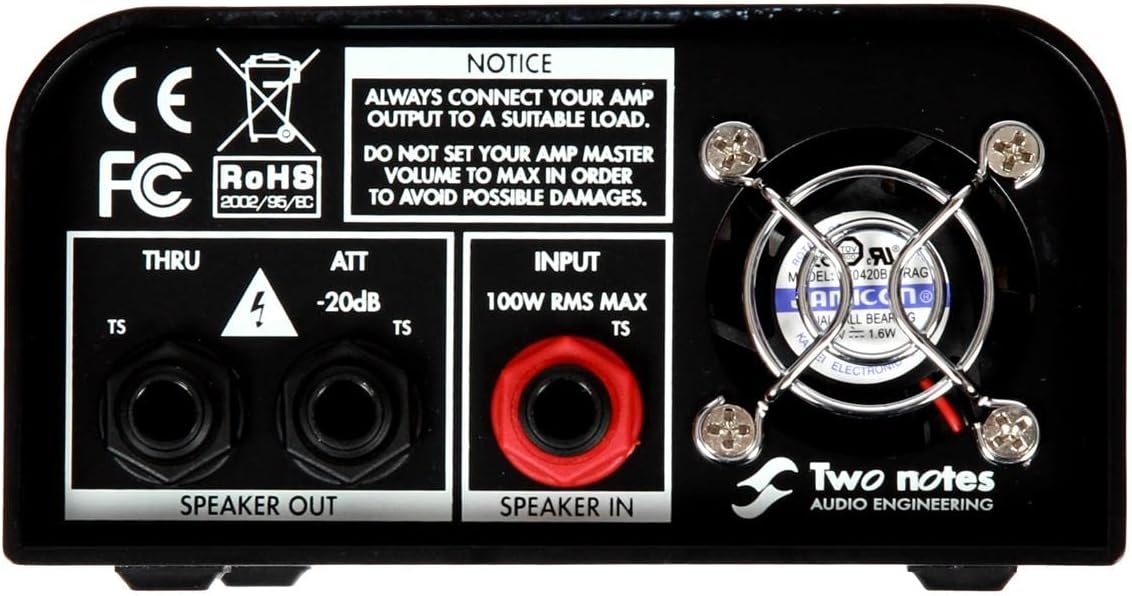
Hình 3.2: Kết nối bảng điều khiển phía sau. This image displays the rear panel of the Torpedo Captor 4, featuring the 'SPEAKER IN' (100W RMS MAX TS) and 'SPEAKER OUT' (THRU and ATT -20dB TS) jacks. A prominent notice warns users to always connect their amp output to a suitable load and not to set the amp master volume to max. A cooling fan is also visible.

Figure 3.3: Front Panel Controls and DI Output. This image shows the front panel of the Torpedo Captor 4, highlighting the 'LINE (DRY)' TRS output, 'DI' XLR output with 'GND LIFT' switch, 'OUT LEVEL' knob, 'PHASE' switch (0°/180°), and 'SPKR SIM' switch (OFF/GTR/BASS). A 48V Phantom Power indicator and a DC input for 9 to 24VDC are also visible.
Các tính năng chính:
- Reactive Load Box: Provides a stable 4-ohm load for your tube amplifier, allowing it to operate safely without a speaker cabinet.
- bộ suy giảm: Reduces your amplifier's output by -20dB, enabling you to achieve cranked-amp tones at lower, more manageable volumes.
- Direct Box (DI): Offers a balanced XLR output for sending your amplifier's signal directly to a mixer or audio interface.
- Speaker Simulator: Built-in analog speaker simulation (Guitar and Bass modes) for the DI output, eliminating the need for microphone placement.
- Đầu ra dòng: An unbalanced 1/4" TRS line output provides a dry signal for re-ampnhập hoặc xử lý thêm.
- Thang máy trên mặt đất: A switch on the DI output helps eliminate hum and ground loops.
- Công tắc pha: Allows for phase inversion (0° or 180°) on the DI output.
4. Thiết lập
Before connecting, ensure your amplifier được tắt và rút phích cắm khỏi nguồn điện.
4.1 Basic Connection (Load Box/Attenuator Mode)
- Connect your tube amplifier's speaker output (ensure it's a 4-ohm output if your amp has multiple options) to the LOA TRONG (TS 1/4") jack on the rear panel of the Torpedo Captor 4. Use a high-quality speaker cable.
- If you wish to use an external speaker cabinet with attenuation, connect the SPEAKER OUT ATT -20dB (TS 1/4") jack to your speaker cabinet. This will reduce the volume by 20dB.
- If you wish to use an external speaker cabinet without attenuation (pass-through), connect the SPEAKER OUT THRU (TS 1/4") jack to your speaker cabinet. The Captor will still provide a load to the amp, but the signal passes through to the speaker at full volume.
- For silent recording or practice, you do not need to connect anything to the SPEAKER OUT jacks. The Captor 4 provides the necessary load.
4.2 DI Output Connection
- Kết nối DI (XLR) output to your mixing console, audio interface, or PA system using a standard XLR cable.
- If your mixing console or audio interface provides 48V phantom power, the DI section of the Captor 4 will be powered automatically. Otherwise, connect a 9 to 24VDC power supply (not included) to the DC input jack on the front panel.
4.3 Line Output Connection
- Kết nối LINE (DRY) (TRS 1/4") output to an input on your audio interface or other processing unit for a dry, unprocessed signal. This output is unbalanced.

Figure 4.1: Torpedo Captor 4 in a Studio Setup (Side View). This image shows the Torpedo Captor 4 placed on top of a guitar amplifier in a studio environment. Cables are connected to the rear panel, illustrating a typical setup for recording or attenuated playing. A studio console is visible in the background.

Figure 4.2: Torpedo Captor 4 in a Studio Setup (Front View). This image provides another perspective of the Torpedo Captor 4 connected to an amplifier in a studio. The front panel controls are visible, along with the connected cables, demonstrating the unit's compact size and integration into a professional audio setup.
5. Hướng dẫn vận hành
5.1 Using the Attenuator
Một khi bạn ampbộ khuếch đại được kết nối với LOA TRONG and your speaker cabinet to the SPEAKER OUT ATT -20dB, you can turn on your amplifier. The Captor 4 will automatically reduce the volume by 20dB, allowing you to drive your amp harder for desired tone without excessive volume.
5.2 Using the DI Output with Speaker Simulation
- Ensure the DI output is connected to your mixer/interface and powered (phantom power or DC adapter).
- Sử dụng SPKR SIM switch to select the desired speaker simulation:
- TẮT: No speaker simulation applied.
- GTR: Optimized for electric guitar tones.
- âm trầm: Optimized for bass guitar tones.
- Điều chỉnh CẤP ĐỘ NGOÀI knob to control the output volume of the DI signal. Start with a low level and gradually increase to avoid clipping.
- If you experience hum or buzzing, try flipping the NÂNG GND công tắc.
- Các GIAI ĐOẠN switch (0°/180°) allows you to invert the phase of the DI signal, which can be useful for correcting phase issues when combining with other signals (e.g., a miked cabinet).
5.3 Using the Line Output
Các LINE (DRY) output provides a direct, unprocessed signal from your amplifier's output, after the load box. This is ideal for re-amping, where you record the dry signal and then send it back through an amplifier or software simulations later. The output level is controlled by the CẤP ĐỘ NGOÀI nhô lên.
6. Bảo trì
- Vệ sinh: Dùng vải mềm, khô để lau sạch bên ngoài thiết bị. Không sử dụng chất tẩy rửa có tính mài mòn hoặc dung môi.
- Thông gió: Ensure the ventilation slots are clear of dust and debris to prevent overheating. Periodically check and clean if necessary.
- Kho: Store the unit in a dry, cool place away from direct sunlight and extreme temperatures when not in use.
- Kiểm tra cáp: Regularly inspect all cables for signs of wear or damage. Replace damaged cables immediately.
KHAI THÁC. Xử lý sự cố
| Vấn đề | Nguyên nhân có thể | Giải pháp |
|---|---|---|
| No sound from DI output. | No phantom power or DC adapter connected; incorrect cable; OUT LEVEL too low. | Ensure 48V phantom power is active on your mixer/interface or connect a 9-24VDC power supply. Check XLR cable connection. Increase OUT LEVEL knob. |
| Hum or buzzing from DI output. | Vòng nối đất. | Thu hút NÂNG GND switch on the front panel. Ensure all equipment is properly grounded. |
| Distorted sound from DI output. | OUT LEVEL too high; ampĐiện áp đầu ra của bộ khuếch đại quá cao. | Giảm bớt CẤP ĐỘ NGOÀI knob. Ensure your amplifier's output is not excessively high, causing clipping at the Captor's input. |
| Amplifier sounds bad or damaged. | Incorrect impedance match; no load connected; amplifier power exceeds 100W. | Đảm bảo của bạn amplifier's speaker output impedance (e.g., 4 ohms) matches the Captor 4. Always connect the LOA TRONG. Do not use with amplifiers exceeding 100 Watts RMS. |
8. Thông số kỹ thuật
- Người mẫu: Torpedo Captor 4
- Trở kháng tải: 4 Ohm
- Tối đa Ampđiện lifier: 100 Watts RMS
- bộ suy giảm: -20dB
- Đầu vào: 1 x 1/4" TS Speaker In
- Đầu ra: 1 x 1/4" TS Speaker Out (Thru), 1 x 1/4" TS Speaker Out (-20dB Attenuation), 1 x XLR DI Out, 1 x 1/4" TRS Line Out (Dry)
- DI Output Power: 48V Phantom Power or 9-24VDC (5mA)
- Speaker Simulation: Analog (Guitar, Bass)
- Công tắc pha: 0°/180°
- Thang máy trên mặt đất: Đúng
- Kích thước: 8.85 x 6.6 x 3.95 inch (22.5 x 16.8 x 10 cm)
- Cân nặng: 2.95 pound (1.34 kg)
- Màu sắc: Đen
9. Bảo hành và Hỗ trợ
For warranty information and technical support, please refer to the official Two Notes Audio Engineering webhoặc liên hệ với đại lý được ủy quyền của bạn. Giữ lại hóa đơn mua hàng để yêu cầu bảo hành.
Tài nguyên trực tuyến: Visit the Two Notes website for the latest firmware updates, software, and additional documentation.


